
17 June 2026
Company Update
80 Mile PLC ('80 Mile' or the 'Company'), the AIM, FSE, and OTC listed exploration and development company with projects in Greenland, Finland and Italy, is pleased to provide an update on recent developments across the Company's portfolio.
Jameson Land Basin
80 Mile is pleased to advise written guidance from the Greenlandic regulator confirming that no third-party licence can be granted over the Company's hydrocarbon concessions covering the Jameson Land Basin, East Greenland (the "Jameson Project"). The Company is pleased with this outcome. It ensures no competing claims can be made over the Company's existing Jameson Project licence area. As the hydrocarbon licensee, only White Flame Energy A/S has the right to apply for all minerals (which includes industrial gases and their derivatives). These additional mineral licences, by law, would only remain valid for so long as they are held by White Flame Energy A/S as the sole licensee.
Should such licences be applied for, these mineral rights would confer to White Flame Energy A/S and hence fall under the Company's existing JV agreement with its partner Greenland Energy Company (Nasdaq: GLND) ("Greenland Energy"), 80M and GLND will now assess the opportunity regarding lodging an application for all mineral rights within its 2.1-million-acre license area.
In parallel, as the Company continues towards drilling to delineate the Project's hydrocarbon potential, 80 Mile's Chief Operating Officer, Olga Solovieva, and Greenland Energy's Chief Executive Officer, Robert Price, recently completed planned community meetings in Ittoqqortoormiit as well as other stakeholder events.
The Company continues to maintain guidance for drilling to start during H2 2026, subject to receipt of final approvals.
Our partner Greenland Energy completed its business combination with Pelican Acquisition Corporation and related entities, transitioning to a public trading company in Q1 2026. Shortly thereafter in April 2026, Greenland Energy closed a public offering that raised approximately $70 million in gross proceeds. These funds are directly supporting the exploration program in Greenland, including procurement of long-lead items and field operations. To facilitate the work in Jamson Land, Greenland Energy secured key contracts with leaders in the oil services industry:
· A five-year drilling agreement with Stampede Drilling for Rig #12, a rig equipped for Arctic conditions, to support our 2026 campaign.
· An agreement with Halliburton (NYSE: HAL) for integrated consulting, logistics, and comprehensive well and drilling services.
· Collaboration with IPT Well Solutions and other service providers to support our drilling and completion activities.
In parallel, as the Company prepares to commence drilling at Jameson at the end of the year, 80 Mile's Chief Operating Officer, Olga Solovieva, and Greenland Energy's Chief Executive Officer, Robert Price, recently completed planned stakeholder and community meetings in Ittoqqortoormiit.
The Company continues to maintain guidance for drilling to start during H2 2026, subject to receipt of final approvals.
Disko-Nuussuaq
At the Disko-Nuussuaq nickel-copper-cobalt-PGE project in West Greenland ("Disko"), drill rigs are now mobilised, with drilling expected to start the first week of July 2026. The drilling programme will initially target high-priority zones at Qullissat, on Disko Island, where large-scale-high-tenor geophysical and coincident geochemical anomalies have been identified, before moving to the mainland later in the season. The planned programme comprises approximately 5,000 metres of drilling across multiple targets on both Disko Island and the Nuussuaq Peninsula.
This fully funded programme represents the first drill testing of the Disko model as part of USFM's US$30 million earn-in commitment to the project, including a minimum US$7.5 million expenditure during the 2026 field season. USFM is solely funding the 2026 drilling programme, with 80 Mile managing the work and retains a 49% free carried position.
Hydrogen Valley
The Company, through Hydrogen Valley, continues to make solid progress at the Greenswitch biofuels facility in southern Italy. The plant is designed to produce biofuels as well as secondary products such as esters from renewable, vegetable-origin secondary raw materials. After an investment of approximately £1.6 million over the last 18 months, the plant is nearing technical completion, and the operations team are in advanced commercial discussions regarding restart.
Greenswitch is a fully permitted and integrated biorefinery in Ferrandina, Basilicata, Southern Italy. The plant has a permitted capacity of 199kt per annum of biodiesel and is in an industrial area, with rail and motorway connections, and close to several major maritime ports. An experienced management team is in place to capitalise on Italy's domestic biofuel production, which is structurally insufficient to meet national demand. The plant has the potential to produce more than 10% of Italy's import needs in biodiesel. Italy prioritises domestic producers over importers, creating a direct pricing and compliance advantage under EU RED III advanced biofuel mandates.
Olga Solovieva, Chief Operating Officer of 80 Mile, commented:
"The clarification received from the Greenlandic authorities is an important development for the Jameson Project. It not only protects our existing hydrocarbon rights but also confirms that no third party can be granted overlapping mineral rights within our licence area, creating additional opportunities across minerals, industrial gases, helium and hydrogen. This further strengthens the strategic value of Jameson as we continue to advance the project towards drilling "
"Drilling at the Disko Project is expected to commence shortly and will represent the first systematic drilling programme ever undertaken in the area. Following several years of geological and geophysical work, we look forward to testing several high-priority targets and providing further updates as the campaign progresses."
"I am currently on the ground in Greenland meeting with local stakeholders and community representatives as we continue to progress the approvals process for Jameson. These engagements have been constructive and form an important part of our commitment to responsible project development."
"With drilling imminent at Disko and continued progress towards drilling at Jameson, we look forward to updating shareholders as further milestones are achieved. Thank you to our shareholders for their continued support and patience as we work to progress these highly prospective opportunities."
For further information please visit http://www.80mile.com or contact:
|
|
80 Mile plc |
enquiry@80mile.com |
|
Ewan Leggat / Caroline Rowe / Devik Mehta |
SP Angel Corporate Finance LLP |
+44 (0) 20 3470 0470 |
|
Harry Ansell / Katy Mitchell / Andrew de Andrade |
Zeus Capital Limited (Joint Broker) |
+44 (0) 20 3829 5000 |
|
Megan Ray / Said Izagaren / Matt Bowld |
BlytheRay |
+44 (0) 20 7138 3204 80mile@blytheray.com |
About 80 Mile Plc:
80 Mile Plc is listed on London's AIM market under the ticker 80M, the Frankfurt Stock Exchange under the symbol S5WA, and traded on the U.S. OTC Market under the ticker BLLYF. 80M is an exploration and development company focused on Hydrocarbons and High-Grade Critical Metal projects in Greenland and an industrial gas and biofuels business in Italy. 80 Mile offers both portfolio and commodity diversification focused on hydrocarbons, base and precious metals, while expanding into sustainable fuels and clean energy solutions in Tier 1 jurisdictions. 80 Mile's strategy is centred on advancing key projects while creating value through partnerships and strategic acquisitions.
80 Mile's Jameson Project covers 8,429km across three licences in East Greenland and represents one of the world's largest remaining untapped gas and liquids-rich basins. An independent 2025 assessment by Sproule ERCE estimated the basin contains 13.03 billion barrels (P10) of recoverable oil, with 80 Mile's retained interest equating to 3.9 billion barrels. In 2025, 80 Mile entered into a milestone agreement with Greenland Energy Company (NASDAQ: GLND), under which Greenland Energy will fund two 3,500-metre exploration wells planned for H2 2026. Upon completion of these earn-in obligations, Greenland Energy will acquire a 70% interest in the Jameson Project, with 80 Mile retaining 30%.
The Disko-Nuussuaq Project, located in West Greenland, covering a district-scale 3,020km2 area. Disko is recognised as a world-class geological setting for copper, nickel, cobalt and PGEs, with potential for a Tier-1 nickel-copper discovery analogous to Siberia's Norilsk Nickel District. The project features multiple walk-up drill targets and which includes seven large, high-priority geophysical anomalies. In late 2025, the company entered into a JV agreement with USFM Corporation under which USFM will fund US$30 million in drilling-related expenditure, including US$10 million in spring/summer 2026, to accelerate drilling and resource definition at Disko. The funding structure will allow 80 Mile to retain operational leadership during the project's critical early stages.
The Dundas Project, located on Greenland's northwest coast, is recognised by independent bodies as the world's highest-grade ilmenite project and the second-largest titanium occurrence globally after Russia. The area hosts high-purity ilmenite, the primary mineral for titanium. Dundas has a JORC-compliant Mineral Resource of 117 million tonnes at 6.1% ilmenite, with further upside highlighted by a late-2024 maiden exploration target of up to 540 million tonnes of additional ilmenite-bearing material. A recent survey by Geological Survey of Denmark and Greenland further impresses on the prospectivity of the area with an estimate of up to 17 billion tonnes (non-JORC) of pure ilmenite within the broader province. With a completed bankable feasibility study and all exploitation permits in place, the project is positioned as a major near-term revenue opportunity for 80 Mile as the company seeks development partners.
80 Mile, through 100% ownership of Hydrogen Valley Ltd, is advancing the Greenswitch Ferrandina Plant in Basilicata, Italy. This fully integrated chemical facility is undergoing final maintenance to commence production of biofuels and Sustainable Aviation Fuel (SAF). Strategically located near the Port of Taranto and within a Special Economic Zone (SEZ), the plant is poised to contribute significantly to Europe's energy transition by producing up to 50,000 tonnes of biodiesel annually, with plans for green hydrogen production. The facility's advanced infrastructure and strategic location underscore 80 Mile's commitment to sustainable energy solutions and regional economic development that supports development.
About the Disko-Nuussuaq Project
Located on the south-west coast of Greenland, Disko has shown its potential to host mineralisation similar to the nickel/copper sulphide mine Norilsk-Talnakh located in northern Russia. Seven significant Magmatic Massive Sulphide ("MMS") targets have been identified to-date at the licence area, with the largest being confirmed now at 5.9 kilometres ("km") long by 1.1km wide. A 28 tonne ("t") boulder of pure massive sulphides assayed 6.9% nickel, 3.7% copper, 0.6% cobalt and 2 grammes per tonne platinum group metals has also been discovered on the licence area. This boulder is on display at the Danish Geological Museum in Copenhagen. A 28t boulder of metal rich massive sulphides clearly demonstrates the significant potential of the project.
A surface sampling programme undertaken by the company confirmed the existence of a working sulphide system (Photo 1) at Disko, initial results returned averaged between 4.6%-9.3% nickel & 1.5-2.8% copper. (Photo 2)
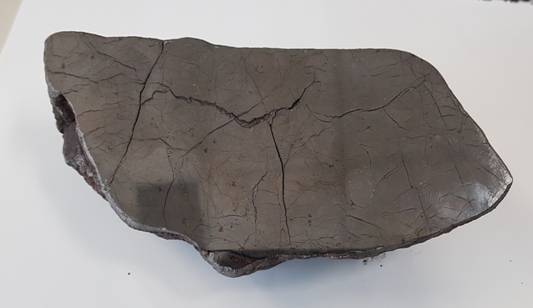
Fresh samples taken from outcrops confirmed characteristics indicative of large-scale Ni-Cu-Co-PGE sulphide segregation and coarse grained inter-locking crystals of metal sulphides were observed in hand specimens with an average crystal size of +15cm indicating that the significant accumulation / precipitation times required for formation of large-scale MMS deposits has occurred. (Photo 3)
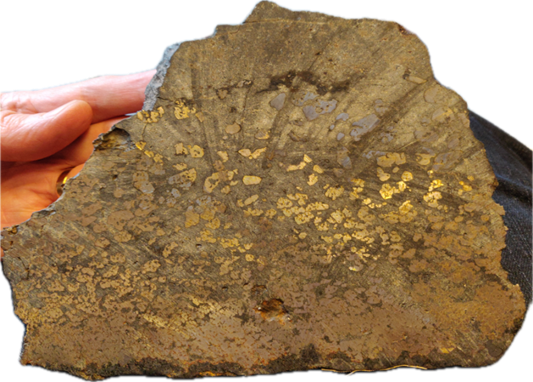
Photo 1 Impressive hand specimen from Disko showing accumulation / settling phase of a metal sulphide rich Picritic Magma.
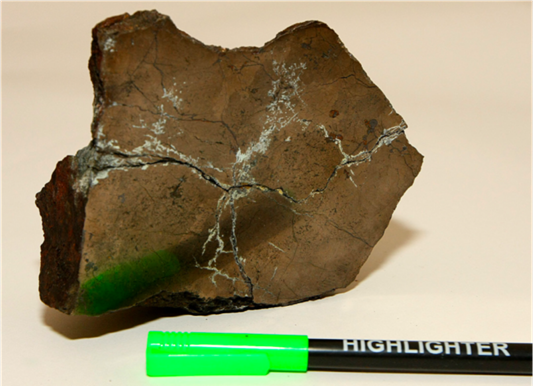
Photo 2 Sample from the Disko boulder that assayed 6.9% Nickel, 3.7% Cu, 0.6% Co, and 2gt PGE
Magmatic massive sulphide deposits are extremely rare and extremely valuable. Notably, based on combined reserves, resources, and historical production, it has been estimated by independent parties that the total value of ores in the Norilsk-Talnakh district surpassed US$1.4 trillion based on 2020 metal prices (Barnes et al., 2020). Disko is estimated to have 28% more picritic lavas than Norilsk. Picritic lavas are magmas sourced from the mantle, a metal dense layer inside the earth and a critical prerequisite for large scale metal accumulations in surficial magmatic massive sulphide deposits.
 .
.
Photo 3 hand specimen of massive sulphide from Disko, large interlocking nickel-copper PGE rich crystals.
The Disko and Nuussuaq Project comprises six MELs covering a total area of 3,015 square kilometres located on Disko Island and the Nuussuaq Peninsula in Central West Greenland. The project area is located approximately 120 kilometres northwest of Ilulissat, Greenland's third-largest city, which serves as the educational, commercial, and administrative hub of Central West Greenland, with a population of 4,700. Ilulissat is well-equipped with essential infrastructure including an airport, deep-water port facilities, and various service providers. Notably, a new international airport is currently under construction and is anticipated to be operational by the end of 2025. Since 2016, 80M has maintained a logistical base in Ilulissat, facilities designed to support its operations at Disko-Nuussuaq projects. Additionally, the Nikkeli operates a modular exploration camp for up to 40 personnel situated at the abandoned coal mining town of Qullissat on Disko Island. The Disko-Nuussuaq Project is hosted within the West Greenland Flood Basalt Province ('WGFBP'). The WGFBP is associated with the initial phase of continental breakup and the onset of seafloor spreading of the Labrador Sea during the early Paleogene. This province serves as a recognized geological analogue to the Siberian Flood Basalts of the Noril'sk Region of Siberia. This analogy was first recognised by Cominco (now Teck) and provided the exploration framework that has guided subsequent exploration efforts.
Information on the Jameson Land Basin Project and Future Strategy
Overview
White Flame was established more than ten years ago and is the 100% owner of three large scale exploration and exploitation licences that cover 8,429 square kilometres of the Jameson Peninsular, east Greenland. White Flame won an international open tender process for two licences and subsequently applied for and was awarded the third in 2014 and 2018 respectively. Since this time, it has maintained the licences in good standing. The licence lifespans are divided into three sub periods (3 years, 3 years & 4 years for a combined total of 10 years before moving into exploitation). White Flame recently received notification of a 3-year extension to the first sub period from the Greenlandic regulators.
The licences are also exploitation licences meaning that if certain preconditions are met and a discovery is made then White Flame has the right to move into production. The licences have approximately 10 years until expiry allowing White Flame to undertake sustained, systematic and detailed work in the entire area. In total White Flame has spent approximately £4m to date on technical work and resource estimates. However, over its history the project area has had investment more than US$125 million all the way to full feasibility studies (in 1989 dollars, meaning far more in today's dollar terms).
Greenland's position into hydrocarbon exploration and licencing
On 24 June 2021 the Greenland Government announced it would cease issuing further hydrocarbon exploration licences. White Flame was informed at this same time that because its licences were valid and in full effect at the time of this policy change, that this new government position would not affect White Flame, its activities or its licence terms and that White Flame was free to continue to develop the Jameson Land Project peninsular as per the conditions in their existing exploration & exploitation licences.
Introduction
The Jameson Land Basin is one of, if not the last, highly prospective, yet completely undrilled basins globally, but with a clear genetic link to the North Sea with basin scale similar to many of the world's major producing regions. This claim is not without foundation; 80 Mile will leverage its acquisition off a comprehensive body of work conducted by US Atlantic Richfield Company (ARCO) between 1970 and 1990 when around US$125m was invested (1989 US dollars) in detailed exploration and evaluation activities. ARCO's work identified multiple, very large gas and liquid hydrocarbon targets.
ARCO's data reverted to the Geological Survey of Denmark and Greenland (GEUS) upon the US major's withdrawal from Greenland in 1990 with the Danish Government continuing work on the project area until 2014 when White Flame was awarded the licences. ARCO and GEUS concluded that the Jameson Land Basin contains all the essential source, reservoir, seal and trap elements to host multiple very-large-scale natural & industrial gas reservoirs in addition to liquid-rich hydrocarbons, particularly in the central and southern central regions of the basin. This data, in addition to many subsequently commissioned independent detailed assessments and reports, indicate there are multiple multi-billion-barrel-equivalent targets within the basin. 80 Mile has identified over 50 targets. Similar sized global analogies to the Jameson gas field are;
1. Maracaibo Basin (Venezuela)
· Approximate area: 8,500 square kilometres (for the primary producing region)
· One of the world's richest liquids and gas-producing areas.
2. Prudhoe Bay Oil Field, (North Slope of Alaska),
· One of the largest liquids and gas fields in North America.
· Oil field is approximately 860 square kilometres (332 square miles)
3. Anadarko Basin (Oklahoma, USA)
· Approximate area: 8,300 square kilometres
· Produces liquids as well as industrial and natural gas.
4. Neuquén Basin (Argentina)
· Approximate area: 8,000 square kilometres (for the core producing area)
· Produces liquids and natural gas.
5. Cooper Basin (Australia)
· Approximate area: 7,800 square kilometres (for the core producing area)
· Known for industrial & natural gas, liquids as well as white hydrogen occurrences.
6. Songliao Basin (China)
· Approximate area: 8,500 square kilometres (for the main producing region)
· Produces liquids, natural and industrial gas.
7. Piceance Basin (Colorado, USA)
· Approximate area: 7,800 square kilometres
· Known for natural and industrial gas production.
The Licences
White Flame owns 100% of the project via a Greenlandic subsidiary, White Flame Energy A/S which in turn holds three exploration and exploitation licences covering 8,429 km² the entire basin on the Jameson Peninsular of East Greenland. The licences are exploration and production licences, are in good standing with the Greenland regulators and very recently had notification of extension of the first sub period for an additional 3 years. After the expiry of this new 3-year extension the licences will still have an additional 7 years before they automatically become exploitation licences, subject to completion of an EIA, SIA as well as a discovery being made.
The Company can confirm it is fully permitted, with documented confirmation that licences are in good standing and that the Company may continue to develop the large-scale gas and liquid rich projects in accordance with the terms and conditions as set out in their existing licences.
History
The Jameson Land Basin, encompassing Blocks 2015/13, 2015/14, and 2018/40, (see figure 1) has a rich history of exploration. ARCO and ENI held licenses for the area until 1990, conducting comprehensive field mapping, sampling programs, and acquiring ±1,800 line-km of 2D seismic data. ARCO's fieldwork, and subsequent studies by the GEUS have continually confirmed the substantial gas and liquid-rich hydrocarbon potential of the basin.
Jameson Land was subject to more than US$100m worth of detailed exploration expenditure between the 1970s and 1990's by ARCO and others which included the construction of what is now the Constable Point Airfield, East Greenland. 80 Mile will leverage off this historical expenditure and infrastructure to fast track the exploration of these various critical gases, including helium, all noble gases and white hydrogen, as well as by-products of other hydrocarbon elements.
ARCO exited all global exploration activities including Greenland as global commodity prices halved between 1984 and 1986. ARCO laid off over 14,000 employees during the late 1980s recession. This culminated in the relinquishment of all its exploration assets including Jameson Land. ARCO did not fully recover from this diminution and was subsequently acquired by BP in 2000 with the Jameson project being relinquished.
Work programme completed prior to withdrawal
ARCO conducted ±1,800 kilometres of 2D seismic over multiple campaigns in Jameson Land. In addition, the company invested heavily in infrastructure including an airport, warehousing and accommodation units. At the time, the structure of the Jameson Concession licences was ARCO 33%, AGIP 33% with the balance free carried by both the Danish and Greenlandic governments.
The data set that ARCO generated from its 2D seismic work reverted to GEUS upon ARCO's withdrawal from Greenland in 1990 and in 2009, White Flame purchased this data, representing over 30 years of high-quality hydrocarbon exploration. Recent legislative changes to the Greenland Mineral Resources Act in September 2014 further facilitated White Flame's 'first mover' opportunity over Jameson Land.
Industrial Gas Potential
The Jameson Land Basin's geological characteristics directly influence its potential for helium, white hydrogen, noble gases (xenon, argon, krypton), and hydrocarbons. In the Jameson Land Basin and the Liverpool Land areas of central East Greenland, helium seeps have been identified and are thought to be related to exist in large concentrations as a byproduct of the deep-seated radiogenic decay of granitic basement rocks. The land adjacent to Jameson has been licensed by Canadian listed Pulsar Helium, who also applied for an industrial gas license over Jameson Land but were refused due to the pre-existence of White Flame licenses.
SUMMARY FINDINGS:
In its core findings, ARCO ranked various formations within the Jameson Land Basin as having the highest potential for all gas types as well as liquid-rich hydrocarbon accumulations in the entire East Greenland and that Jameson represents approximately 50% part of the highly productive ±50% of the original area currently known as the Haltenbanken field, North Sea but expresses as an uplifted and onshore part of the basin. All historical assessments concluded that the entire area is extremely prospective, with all the necessary characteristics for the accumulation of gas and liquid hydrocarbons and that large-scale system present throughout the Jurassic and Triassic sedimentary pile with excellent source and seal and permeability characteristics of global scale with walk up drill targets.
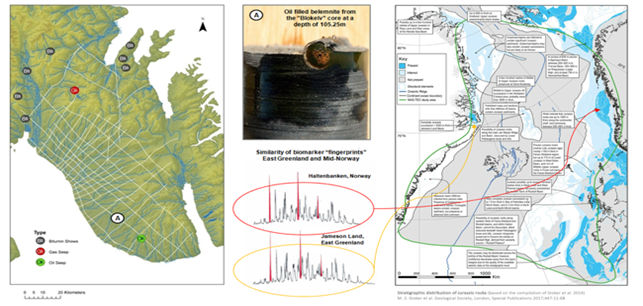
Figure 4 Hydrocarbon biomarking demonstrating common ancestry between geological regions.
Following early success of the North Sea, in the 1970's ARCO undertook early field studies into the western Atlantic margin (east Greenland) and concluded that the Jameson Land basin was highly prospective and was historically part of the oil rich North Sea basin. In the early 1980's a group comprising ARCO and ENI acquired ±1,800km of 2D seismic and conducted several further seasons of fieldwork, all of which pointed to the strong likelihood of a working gas and liquid system. Unfortunately for ARCO later that same decade market conditions forced ARCO to exit frontier exploration, including Jameson and they never recovered subsequently being taken over by BP in 1990.
The Geological survey of Greenland and Denmark also concluded that Jameson contains all the essential elements: source, reservoir, seal and trap, for a successful and potentially commercial reservoir of gases and liquids. In particular, the work conducted to date would imply that there is major source rock and reservoir potential within the basin and several drillable targets within a total stratigraphic thickness of 17,000 metres of the basin.
The basin remains undrilled despite direct field observation of source rocks and reservoir systems and the presence of multiple hydrocarbon seeps and a clear genetic linkage to the North Sea Haltenbanken oil field. Consequently, this venture provides a unique and very exciting opportunity to explore and drill one of the few remaining frontier basins on the Atlantic margin.